
 |
Brief: Maelzel
Johann Nepomuk Maelzel ( 1772-1838 ) registered the metronome
patent in 1815 after devising the musical scale for a device
largely constructed and invented by Dietrich Nikolaus Winkel a
year earlier. Maelzel started production of the metronome in
Paris 1816, gaining praise and publicity from none other than
Beethoven himself and who he was later to fall out with, over
rights issues for "The Battle of Vitoria". Maelzel was widely
travelled, promoting and selling numerous musical inventions and
automated wind and cog driven devices, ranging from ear
trumpets, chess players, pan harmonicons, rope-dancers and
speaking dolls, twice visiting the West Indies, Munich, Vienna,
Paris, London and the United States. Although greatly respected
and successful in his own right, Maelzel also had an ability to
seize on the ideas and works of others and use them to his
benefit. There are two reports of how he died in 1838, neither of
which I have been able to confirm. The first that he died from
alcoholism on a ship in the harbour of La Guaira, Venezuela, the
second was that he died while sailing on a brig, "the Otis"
travelling from Havana to Philadelphia, but not before
establishing a highly successful musical accessory business.
THE INFORMATION SHOWN ON THIS PAGE AND
WEBSITE IS COPYRIGHTED AND IS NOT TO BE COPIED, DISTRIBUTED OR
SHARED WITHOUT PRIOR CONSENT. Individuals who ignore this request
will face legal action. The information listed is our own
interpretation of the Maelzel production timeline and is open to
debate, updates and correction.
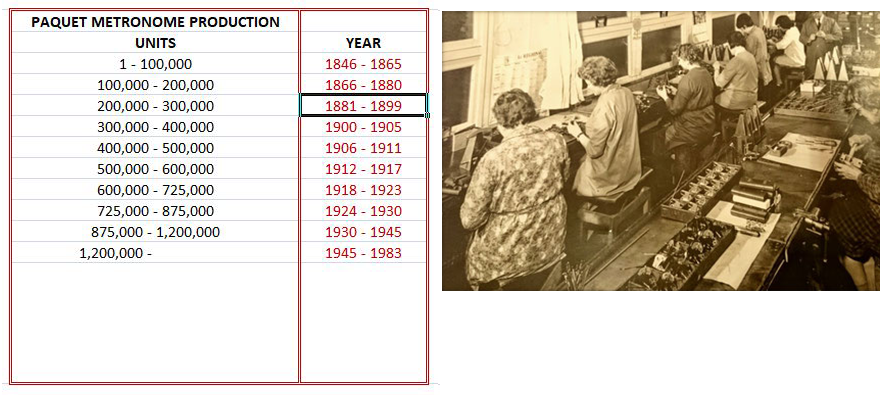
The Maelzel Metronome Production Timeline - A Work in
Progress.
It is widely accepted and documented that Maelzel, after
stealing and copying Winkels invention in 1813, had abandoned
his own time keeping devices that he was working on, which bore
a striking similarity to Winkels own metronome, and sourced a
specialist horology workshop ( who we think was the French
watchmaker Bernard-Henri Wagner and later Jean Wagner ) to construct an initial 200 pyramid
style metronomes, which he gifted to composers and music
publishing companies and institutions Worldwide. He also wasted
no time in getting drawings assembled and applying for a
French
Patent in September 1815. This initial 200 devices appears to
have been an adhoc assembly of various experimental designs in metal, of a
rather gaudy appearance, constructed with the intention to
impress and probably to order depending on the recipient. It has
long been thought that one of these initial 200 metronome's was
gifted to Beethoven in 1815, which allegedly was tracked down
years later, by Peter Stadlen in an Antique shop, but more on
this later.
Maelzel himself gives another description of an early production
metronome on Dec 17th 1816 after a theft from his studio in
Regensburg. The police report states: "Between the
6th. and 9th December, that a metronome has been stolen. This
instrument gives all the gradations of the musical measures of
time. Its exterior is in the shape of a portable little obelisk
or pyramid. It is a foot high, made of green lacquered sheet
metal, and has an oval round gilt shield in the middle, on which
the artist's name, Johann Mälzel. From the anterior wall,
whereupon the shield is, the upper section can be pulled out and
then shows the scale. The interior contains a simple mechanical
apparatus with a scale on which are numbers and which resembles
the scale of a thermometer So far, very few examples of this
instrument have been sent to the Continent by its inventor, the
mechanic Mälzel" While this theft or metronome has
no known links to Beethoven, it is another indication of the
different styles & variety of units that Maelzel had produced or
was experimenting with, prior to 1817.
 |
 |
 |
 |
| Maelzel Pulley
Pendulum c1820 Scale 50-160bpm |
French
Manufactured c1815 ( B.H. Wagner ) Scale 50-160bpm |
French
Manufactured c1818 ( J. Wagner ) Scale 50-160bpm |
London
Manufactured c1825 ( Prowse Co? ) Scale 50-160bpm |
After the enthusiastic acceptance of the Metronome from acclaimed
musicians Worldwide and as word spread and demand soared, Maelzel was quick to establish a similar workshop in London
using a completely separate company ( possibly William Prowse, Robert Cocks or Johan Cramer ) for production and to
apply for an English Patent on 1st June 1816 No. 3966.
Paul Charbon – Museum of History Strasbourg in the 1960's wrote and I quote
:
" The accompanying drawing reproduced for
the first time the device in the form we know it: a Wooden box
of pyramidal shape. By removing a side cover, we discovered the
inverted balance with its weight in the shape of a triangle,
capable of sliding in front of a scale graduated from 50 to 160.
In 1817 after reconciling with Beethoven over his stolen sonata
he gifts him a 31cm (12") wooden metronome with a plaque that
read “ By Letters Patent
with the Royal Mottoes "Honi soit qui mal y pense" et "Dieu et
mon droit", and with the dedication
"Maelzels Metronome London ".
Now this extract is important, and I have been unable to
find Charbons source but he is undoubtedly describing a London
made metronome, as shown below and not a Wagner or French made
metronome as found by Stadlen. Beethoven's nephew, Karl was
reported to have auctioned Beethoven's belongings, to include his
metronome after his death in 1827 and it was located in an
antique store years later. This to us at first seemed highly unlikely,
as it does not tie in with Charbons unmistakable description of a
London manufactured metronome. However, it could still make
sense if Beethoven was in fact gifted or made use of more than
one Maelzel metronome. We believe however that the initial 200
Maelzel metronome's constructed in the 9 months between both the
French Patent and English Patents, were made of tin plate, as per
the Maelzel English Patent filed in June 1816 No 3966
quote: " which then receives the blow, and makes a
sufficient sound, when the machine is enclosed in the pyramid A,
B, C, Fig. 1 and 2, which may be made of tin or other
metal ".
The two images on the right, shown below are from a London
manufactured metronome from the Prowse Company dating to
around 1830. The form or height on this example has been reduced
by 1825 from 12" to the more typical and standard size of 9". Also the tempo scale or timings was enlarged
after Maelzel acted upon input received from Beethoven in 1821 changing
from 50-160bpm to 40-200bpm. However the London manufactured
metronome that we show here, was very
similar to the one gifted to Beethoven in 1817 which would have been 12"
high, without a bell and with the smaller tempo scale markings
and probably manufactured by William Prowse before he
merged with Robert Keith to form the Keith / Prowse
Company.
|
|
 |
 |
 |
 |
| Beethovens
Alleged Metronome c1815 Scale 50-160bpm 12" high Maker - Bernard Wagner- France |
French
Manufactured c1815 ( B..H Wagner ) Door Emblem |
English
Manufactured c1817 ( W.Prowse ) Door Emblem |
A Later version
of the London Manufactured Metronome Possibly Gifted to
Beethoven in 1817 c1830 Scale 40-200bpm 9" high Maker - W. Prowse - England |
Our own opinion regarding the Beethoven metronome is that he almost certainly made use of, or was gifted more than one, and the Alleged Beethoven Metronome shown in Fig 1 above actually dates to around 1818 or later.
By 1818 having gained the approval of numerous notable musical
composers around the World and the acceptance of his metronome, Maelzel instructed
both of his workshops in London and Paris to reduce production
costs, and in turn halving the asking price, opting for less bling,
such as ivory inlay, and metal fret working and instead
standardized assembly, giving
the customer the option of higher cost items on request. His
French sales brochure from 1818 reads:
a) Those of ordinary pyramidal shape are 50 francs
b) Those in pedestal form at 25 francs
c) Those shaped truncated pyramid, without sound ( silent
) at 10 francs.
d) There are selected woods, as well as metallic moiré, with
ornaments gilded, the price of which is higher than ordinary
ones.
By 1821 and with minor refinements and improvements to the mechanism's,
both of which differed hugely between France and England and
having listened to requests for expanding the scale, adjustments
and patents where updated, by which time he had already acquired
patents in England, Austria, France and Bavaria. We think around
1825 a smaller metronome was introduced, reducing the standard
12" pyramid form by 3" to the smaller and more compact 9" and
lowering costs at the same time. The option to purchase
either size was still readily available as late as
1833, as shown on the Jean Wagner French Sales Brochure.
Maelezel had by 1831 also added a bell assembly that rang on
every 2,3,4,or 6th beat for an additional cost. This design or
at least the idea was in fact also stolen from another inventor,
Bienaimé Fournier, again by Maelzel and incorporated into the
metronome design and patent by Wagner in 1832, on Maelzels
behalf.
a) Small ordinary mahogany metronome 25 francs.
b) Small metronome, varnished mahogany, ivory inlay 28 francs.
c) Large metronome ordinary, mahogany 30 francs.
d) Large metronome, varnished mahogany, ivory inlay 34 francs.
e) Metronome marking the first time of the measure ( with bell )
40 francs.
Footnote: We actually think that Maezel would
have supplied Beethoven with several different versions of his
metronome throughout their acquaintance and up until his death
in 1827. He was Maelzels most important customer and advocate
and knew that convincing Beethoven of the merits of a reliable
metronome and gaining his approval, would mean that Worldwide
acceptance of the metronomic principle may follow. Our research
regarding these early Maelzel metronomes and the types and
styles of metronome that followed is available to view for a
small charge by clicking the red button at the top of the page.
We apologize that we can not make this information freely
available but numerous sources keep stealing our published
research.